




















Today’s systems are more interconnected and complex than ever. It's astounding to see how things have changed in just a few years, and there's no end in sight. Engineers now heavily depend on accurate data and reliable traceability to maintain projects on track. At SodiusWillert, one of our core missions is to help them face this new and evolving reality with tools that integrate better, automate more, and remove unnecessary friction from daily workflows. Throughout 2025, we expanded our product portfolio, strengthened our interoperability capabilities, and introduced new approaches to support engineers where it matters most.
As we close the 2025 chapter, here is a look back at what we delivered, what we learned, and how this year’s work and meetings with our community all around the world have prepared us for the road ahead.
Product Milestones: less friction, more continuity
OSLC Connect for Jira: extending traceability to testing
We started 2025 strong by expanding tool support in one of our flagship OSLC-based products, OSLC Connect for Jira. With the addition of Xray Test Management for Jira, we took an important step forward, closing a gap in end-to-end lifecycle traceability.
Our mission with OSLC Connect for Jira has always been clear: enable engineering teams to work with the tools they prefer, while ensuring reliable, secure, and standards-based traceability across the toolchain. In regulated and safety-critical industries, traceability is not optional; it is the backbone of compliance, visibility, and safety.
By adding support for Xray Test Management for Jira, teams can link test cases and test results directly to requirements in IBM DOORS Next or SIEMENS Polarion Requirements. This creates a continuous, navigable thread from requirements to verification across all stakeholders. The result is not only better reporting, but a shared and real-time understanding of project status and coverage.
➡️ Read more about this new integration
|
New enhancements for TRS (Tracked Resource Set) in OSLC Connect for Jira This year, our team worked hard to make data integrations more robust, scalable, and manageable. Major improvements were delivered to the TRS (Tracked Resource Set), the component that exposes Jira artifacts to IBM ELM indexers such as LQE and LDX. Our latest release adds improved Jira cluster performance, deferred bulk operations, and enhanced admin tools, including audit logging, inconsistency repair, and forced updates. |
Publisher for SPARX Enterprise Architect: a long-requested EA-to-Cameo converter
Interoperability at the model level has always been a challenge for systems engineering teams working across heterogeneous tools. At SodiusWillert, we make it our mission to enable accurate, ready-to-use model exchanges in just a few minutes and support long-term digital continuity across MBSE toolchains.
In 2025, we addressed a frequently expressed need by introducing Publisher for SPARX Enterprise Architect, the new member of the Publisher family. Many organizations rely on SPARX EA for SysML and UML modeling, while projects require models in Cameo Systems Modeler. Until now, this often meant manual rework or inefficient XMI imports/exports.
Publisher for SPARX Enterprise Architect allows systems engineers to convert SysML and UML models from SPARX EA into Cameo-compatible models, while preserving model elements, structure, diagrams, and hierarchy during conversion.
➡️ Read more about how to convert SysML and UML models from SPARX EA into Cameo
AI Modeling Assistant for IBM Rhapsody or a new era of Practical AI in MBSE
2025 was also the year we introduced our very first AI-powered modeling assistant in IBM Rhapsody. Since the rise of generative artificial intelligence, many Rhapsody users and peers have expressed a wish to see this new technology applied to their daily engineering challenges. We heard them, and the AI Modeling Assistant for IBM Rhapsody is our answer to this request.
Embedded in Rhapsody, this helper supports users with their daily systems and software engineering tasks. More specifically, it focuses on areas that consistently slow projects down if they are not carried out with the right resources and tools:
- Creating models from natural language requirements
- Reverse engineering large or undocumented codebases
- Checking models for consistency and traceability
AI Modeling Assistant does not replace engineering expertise; it takes over the repetitive parts of the job, so that engineers can focus their attention on architecture, design choices, and system behavior. Engineering judgment still has many years to go, and having a bit of assistance along the way can make all the difference.
➡️ Read more about our very first AI modeling assistant for IBM Rhapsody
We now have 4 IBM Champions!
On the people side, 2025 also brought excellent news: the SodiusWillert IBM Champion community grew again. On February 6, IBM announced the IBM Champions for 2025. Three of our existing champions renewed their titles: Walter van der Heiden, Andy Lapping, and Martin Stockl. And Johannes Trageser joined the crew as a new Champion.
Product Owner for Modeling and Code Generation solutions at SodiusWillert since 2015, Johannes has been particularly active around model-based software development for safety-critical embedded systems. Many of you may have met him at events like REConf, MESCONF, ESE Kongress, and many others.
Our four champions have a deep practical background in modeling and IBM Rhapsody, built through years of work on complex embedded systems engineering projects. They genuinely enjoy sharing their know-how through training, customer projects, and conference talks.
As for us, we see these recognitions as confirmation that our teams do not just build tools; they also contribute actively to advancing practical engineering practices across the community. And they do it impressively well!
Meeting you in person: from MBSE and Requirements Engineering to Defense and Automotive
As always, in-person exchanges and discussions remain essential for us to understand how engineering practices evolve beyond tools. And 2025 was no exception. Our teams engaged actively with the community across Europe and North America, using these moments to not only introduce our solutions, but also to listen and learn.
Here’s a short retrospective:
🔹 Across MBSE and systems engineering events such as the INCOSE International Workshop, MBSE Cyber Systems Symposium, GPDIS, and the INCOSE MBSE Symposium, discussions largely centered around SysML v2, Mission Engineering, and the growing need for maintaining digital continuity. This is precisely what Jeff Pilato highlighted by illustrating SodiusWillert’s expertise in supporting model-based collaboration and strengthening data continuity throughout the lifecycle.
🔹 In requirements and embedded development areas, we spoke at REConf, the IBM Engineering Symposium, and marked MESCONF’s 10-year anniversary. We also delivered multiple sessions at ESE Kongress focused on UML for embedded systems, AI-assisted engineering insights, and MBSE for mixed-signal architectures.
🔹We also engaged in aerospace and defense events such as AFCEA, the Digital Engineering for Defense summit, and NDIA’s Systems and Mission Engineering Conference. Discussions at these conferences confirmed long-standing themes around digital thread implementation, interoperability, and compliance at scale are largely shared across industries.
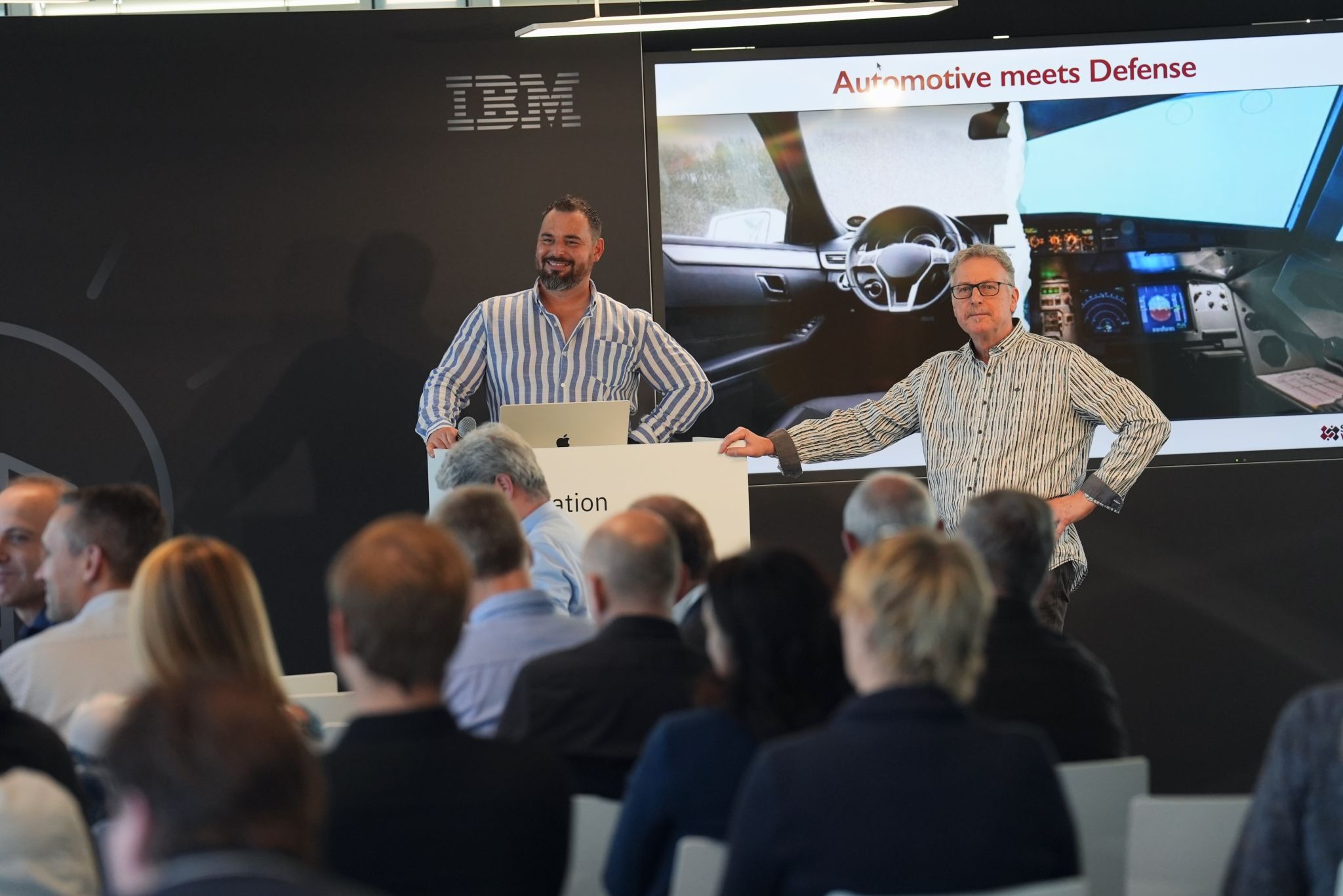
🔹 We also hosted the 2025 edition of our highlight of the year, Automotive Day. In retrospect, this new edition confirmed trends that are sure to be talked about in the months to come:
- AI as a core element in the engineering toolbox,
- The increasingly tight links between Automotive and Defense, especially when it comes to systems complexity and compliance.
- The need for engineering data to be more sharable and reusable
A sincere thank you to everyone we met at these events, and to all speakers and attendees who continue to share with sincerity real-world experiences!
Looking ahead to 2026: OSLC Connect for Jira Cloud
Finally, 2025 was also about preparing for a major, but clear shift in the Atlassian ecosystem. For almost a decade, we have supported OSLC-based integrations between Jira and tools like IBM ELM, Siemens Polarion, and CATIA Teamwork Cloud through OSLC Connect for Jira. With Jira Server now retired and Data Center scheduled to end in 2029, many organizations are planning or executing their move to the Cloud. But a recurring question still comes up: how to keep OSLC integrations and traceability intact when moving to Jira Cloud?
Well, our answer is now becoming concrete with OSLC Connect for Jira Cloud coming in Q1 2026!
This new Cloud-compatible solution is designed to deliver the same level of capabilities that customers rely on today: cross-tool linking, artifact navigation, live previews, standards-based interoperability, and more, all adapted to Atlassian’s Cloud ecosystem. Our objective is continuity. We aim to support our customers’ migration plans without compromising traceability, compliance, or engineering workflows.
And since actions speak louder than words, check out the three exclusive demos Robert Baillargeon, our OSLC and Linked Data guru, has put together for us before the official release.
📺 Watch the demos

Thank you!
2025 was an intense but rewarding year. It brought new integexpanded automation capabilities, our first AI assistant for MBSE, and countless opportunities to engage and explore ideas with engineers working in some of the most demanding industries.
Throughout the year, we stayed guided by a simple principle: engineering tools should focus on quality and durability rather than fleeting trends. Interoperability only matters if it fits real engineering workflows. And partnerships only work if they are built on trust and shared understanding.
As we move into 2026, we will continue to focus on:
- Delivering robust, standards-based interoperability,
- Supporting engineering teams with practical integrations,
- Built interoperability that fits real engineering workflows
- Staying close to our customers, not as a vendor in the background, but as a true partner you can call.
We sincerely thank our customers, partners, and community for their continued trust and collaboration throughout the year.
We look forward to supporting your projects again in 2026.


Leave us your comment