











Jira Cloud and IBM DOORS Next integration

Connect your development and systems engineering teams with live, bi-directional requirements traceability. Powered by OSLC Connect for Jira.

Available for Jira Cloud and Jira Data Center.

preview-jira-issues-in-doors-next
OVERVIEW

About our Jira + IBM DOORS Next OSLC-based integration

In regulated engineering programs such as oin automotive, aerospace, defense, medical devices, requirements live in IBM DOORS Next and development work lives in Jira. Two tools, two teams, and a traceability gap that engineers fill manually: copying requirement into Jira descriptions, exporting spreadsheets before reviews, or waiting for someone to pick up a change.

OSLC Connect for Jira eliminates that gap. It connects IBM DOORS Next and Jira Software and uses the using the OSLC open standard to enable live, bi-directional links, so data stays authoritative in its source tool and both teams see it in real time. No data migration, no synchronisation, no duplication. Requirements stay in DOORS Next. Issues stay in Jira. Everyone works in the tool they already use.

oslc-logo

Standards-based integration

Built on OSLC, an open specification already used across IBM ELM, and other lifecycle tools so your traceability investment isn't locked to one vendor's roadmap.

Bidirectionality-icon-SodiusWillert-100x100px-color

Live bidirectional links, no data duplication

Links are discovered and resolved in real time. Requirements, defects, and test results stay where they're authored, with no batch sync, no stale copies, no reconciliation jobs.

Safety-icon_SodiusWillert_100x100px_color

Built for Regulated Engineering

Global Configuration support keeps traceability accurate across product variants and baselines, a requirement in automotive ASPICE and A&D DO-178C/DO-254 environments.

KEY INTEGRATION CAPABILITIES

Jira Cloud and IBM DOORS Next integration capabilities

Capabilities that cover the full traceability lifecycle, from creating the first cross-tool link to feeding live relationship data into compliance reports, without leaving the tool your team already works in.

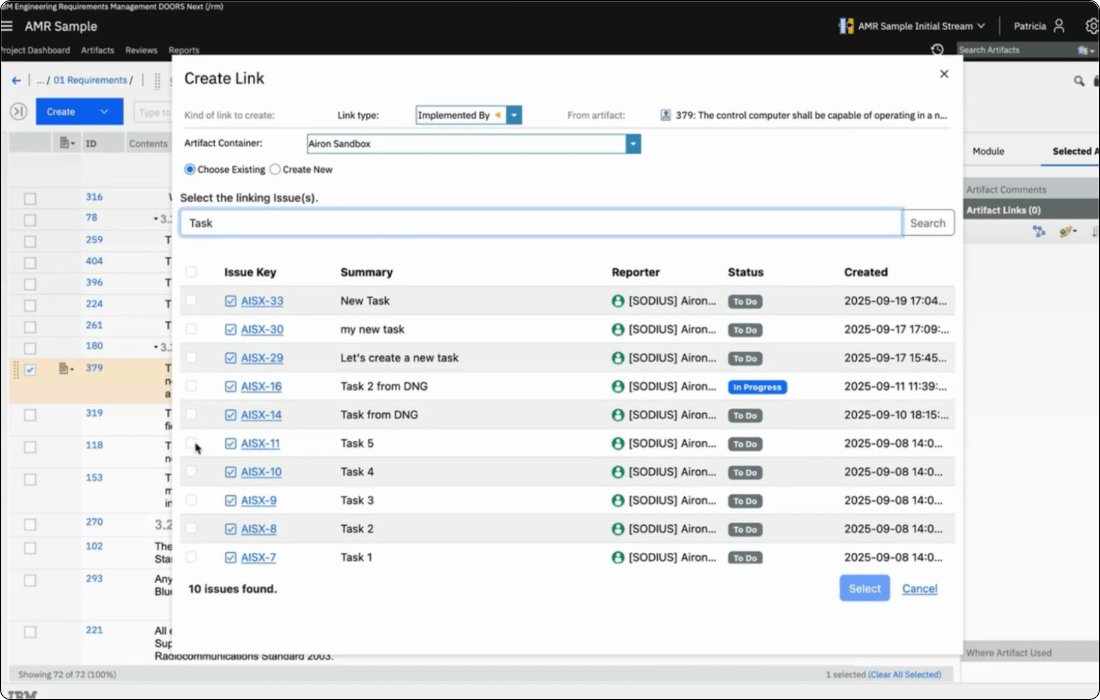
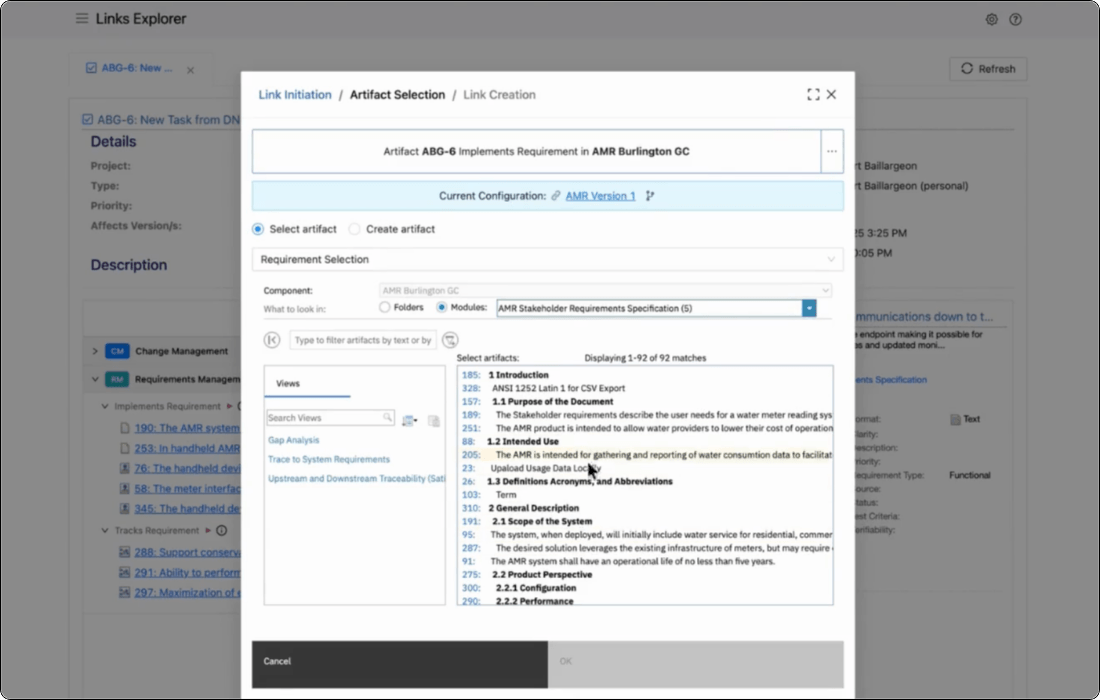
Link to existing Jira issues from IBM DOORS Next

From any DOORS Next artifact, open the OSLC selection dialog to search and filter Jira issues by project or type, then select one or several to link.

OSLC Connect for Jira will set the correct Jira issue type automatically based on your administrator's mapping (for example, a DOORS Next functional requirement creates a Jira Story; a DOORS Next defect creates a Jira Bug). The relationship (e.g. "implemented by") is established in both systems simultaneously, with no need to open Jira to confirm it.

Traceability is established at the source, without switching tools or maintaining it in two places.

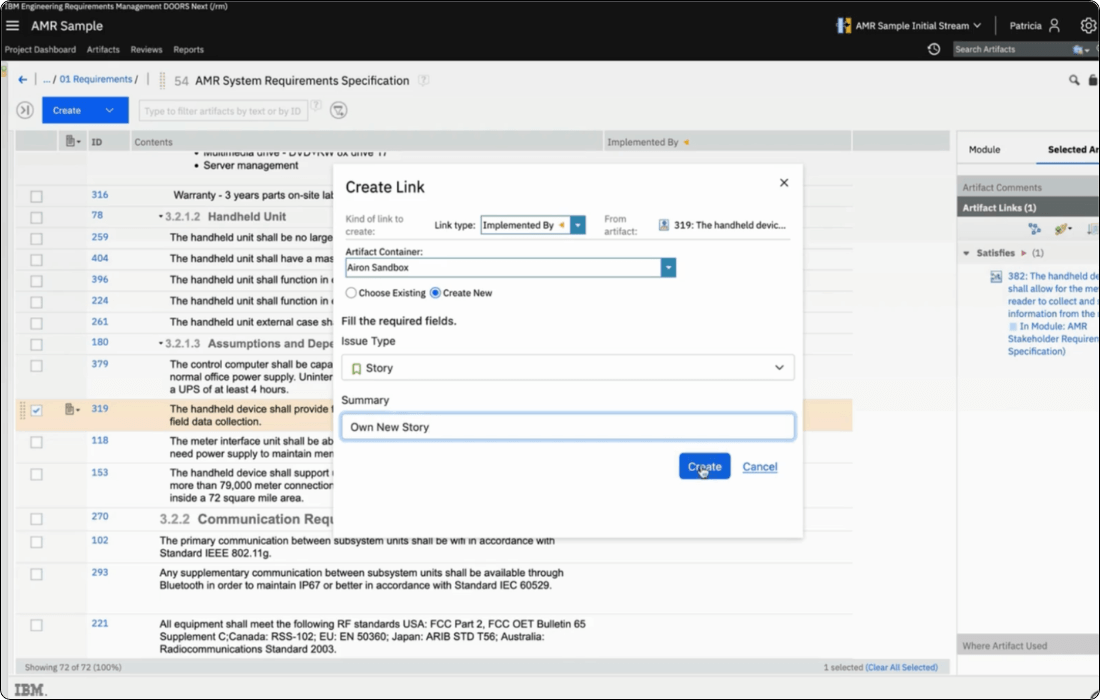
Create new issues from IBM DOORS Next

If no Jira issue exists yet for a requirement, teams in IBM DOORS Next can create one from within DOORS Next without leaving the requirements tool.

The new issue appears immediately in Jira and is linked back to the originating DOORS Next artifact automatically.

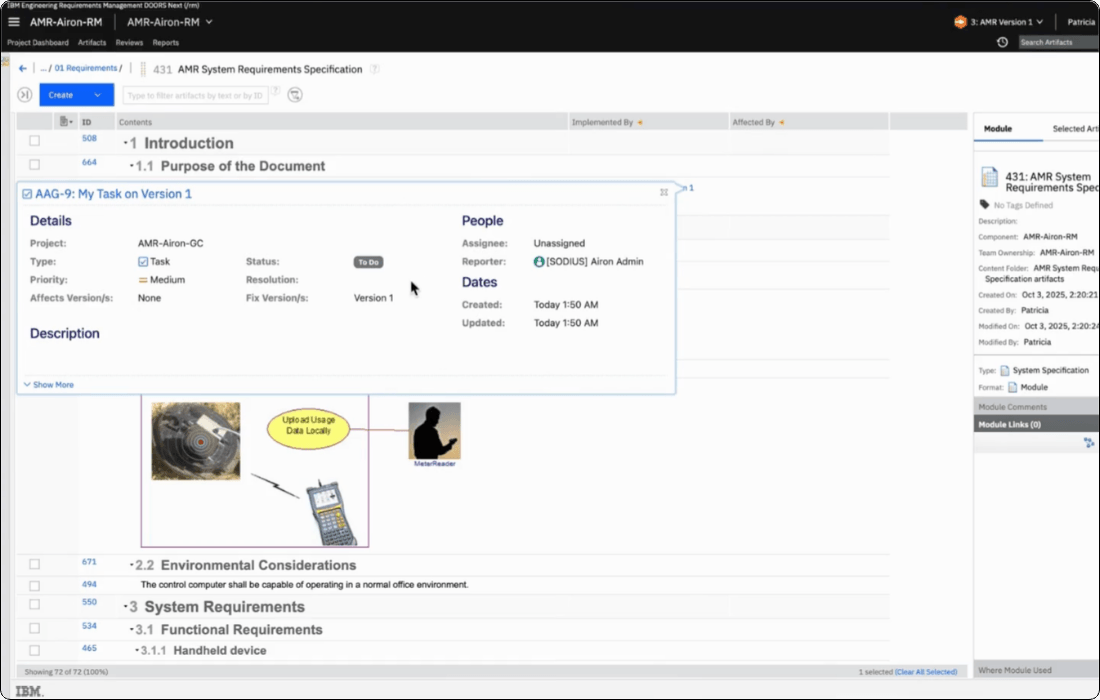
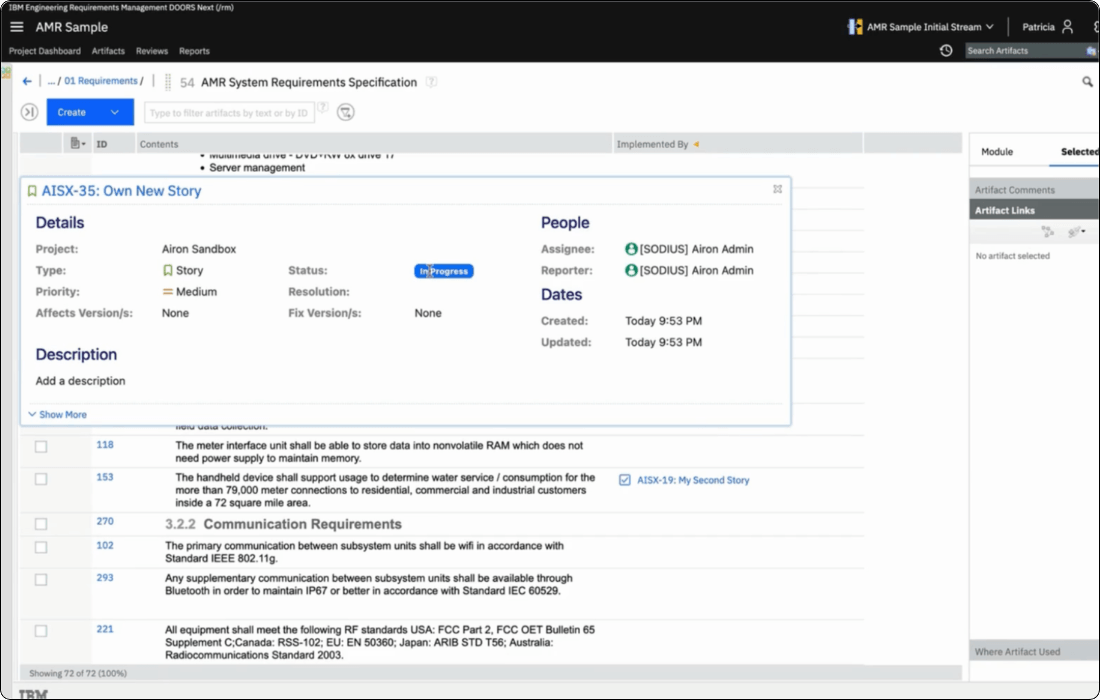
In IBM DOORS Next, preview live Jira data.

In DOORS Next, systems engineers can rich hover over a linked Jira issue and see its assignee, status, sprint, description, and other attributes that are pulled live from Jira Cloud at the moment of viewing. No need to switch tools, and no stale snapshot.

Preview content is configurable per artifact type, and all previews respect the native access controls of both tools.

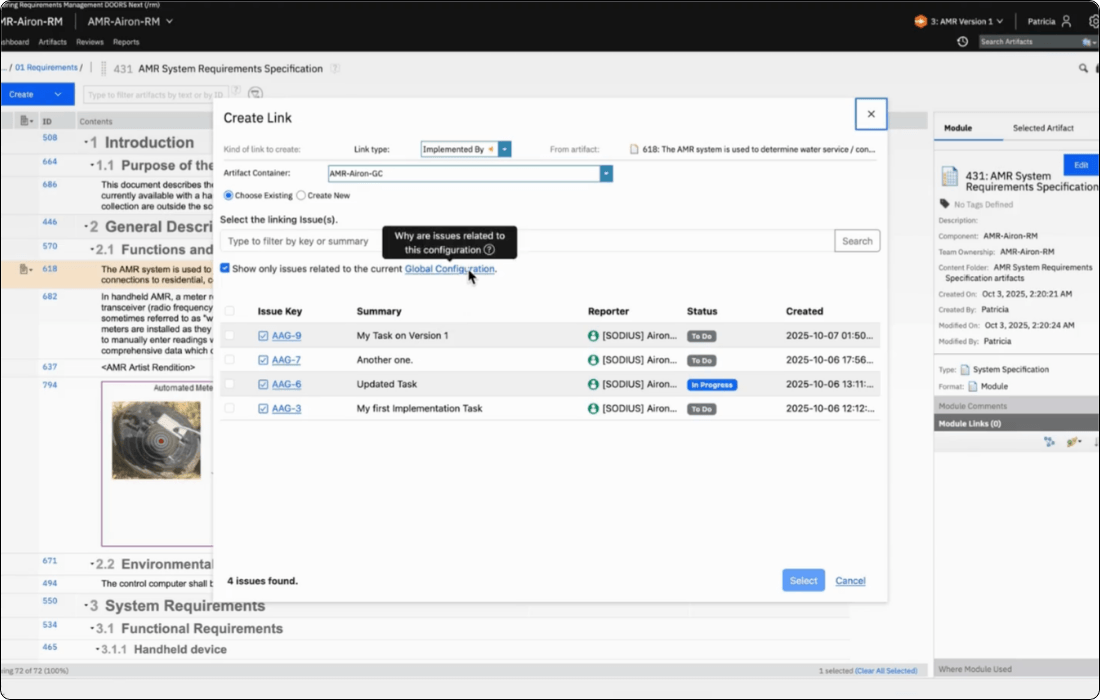
Leverage across IBM Global Configurations

When working in a specific DOORS Next Global Configuration, the selection dialog filters to Jira issues associated with the corresponding fix version, and any new Jira issue created is automatically assigned to that version. Switching configurations surfaces the matching set of Jira artifacts for that baseline.

For Programs managing multiple product variants, this allows teams to get accurate, per-baseline traceability instead of a flat view that mixes releases.

See OSLC Links inline on any Jira issue

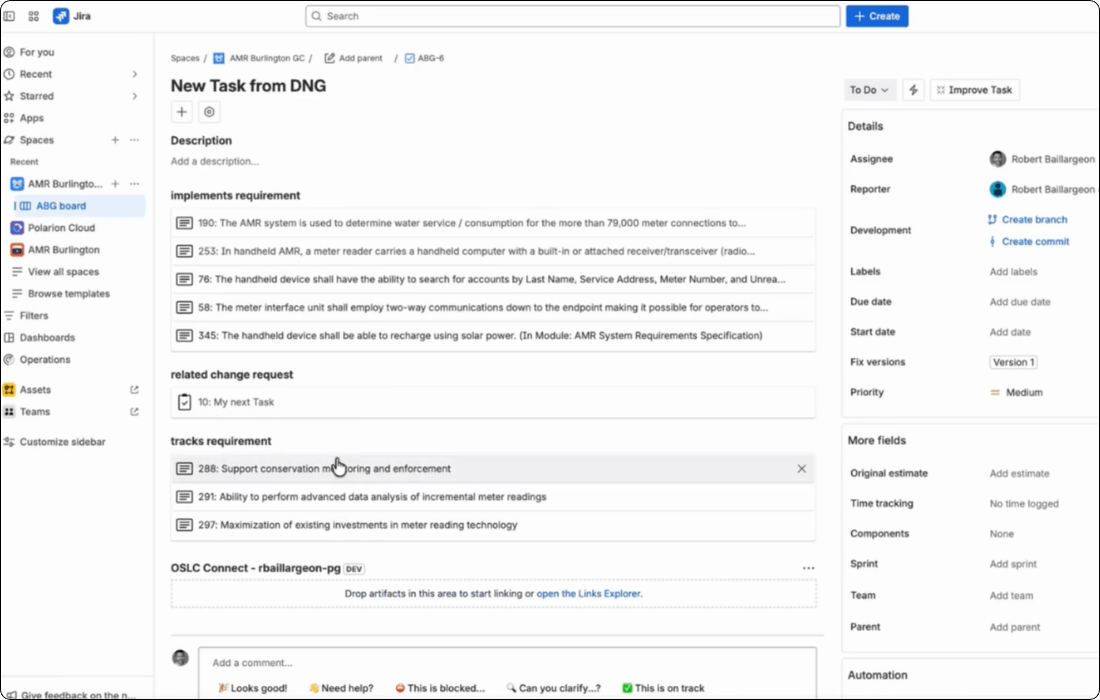
OSLC links to DOORS Next requirements are visible on every linked Jira issue.

Delivery teams can see at a glance which requirements their work traces back to, along with the artifact type and a reference to the linked item, without needing access to DOORS Next.

This allows Jira users to stay informed about requirement context without disrupting the DOORS Next authoring environment or needing additional tool licences.

Explore and manage links in the Link Explorer

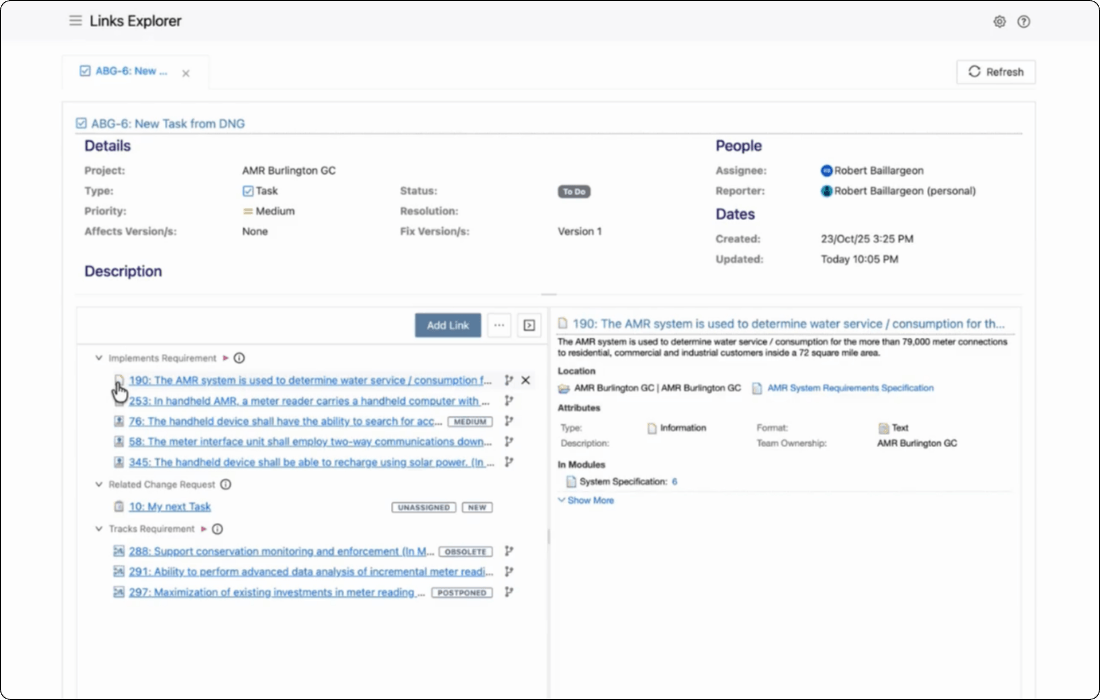
The Link Explorer gives Jira users a dedicated space to engage with OSLC links.

View, sort, filter by domain (requirements, test, change), open rich previews of linked artifacts, create new links via dialog or by dragging a DOORS Next artifact directly onto the explorer, and navigate to the linked item in its source tool.

Delivery teams get full link management without needing access to or training on DOORS Next. The link creation and review can happen inside the Jira interface they already use every day.

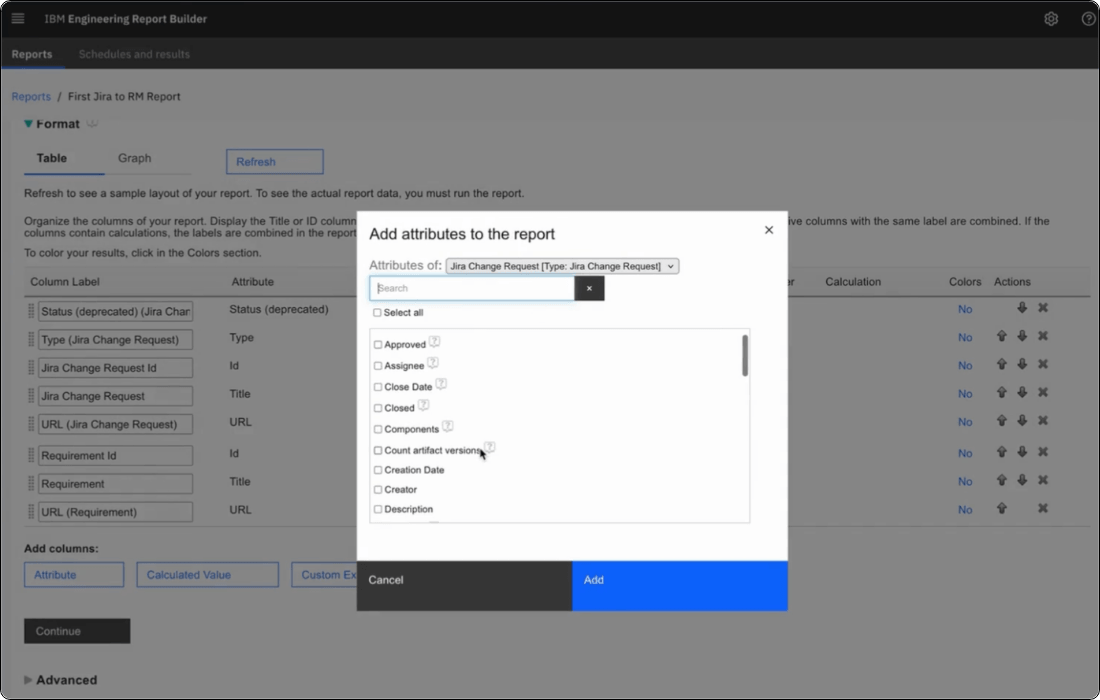
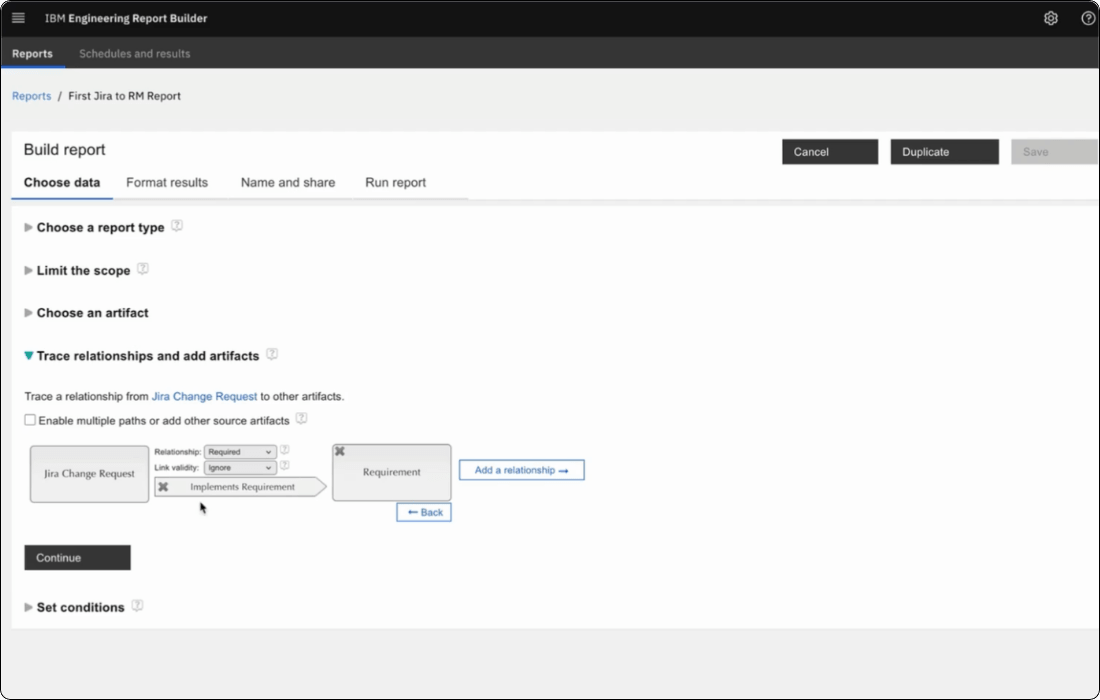
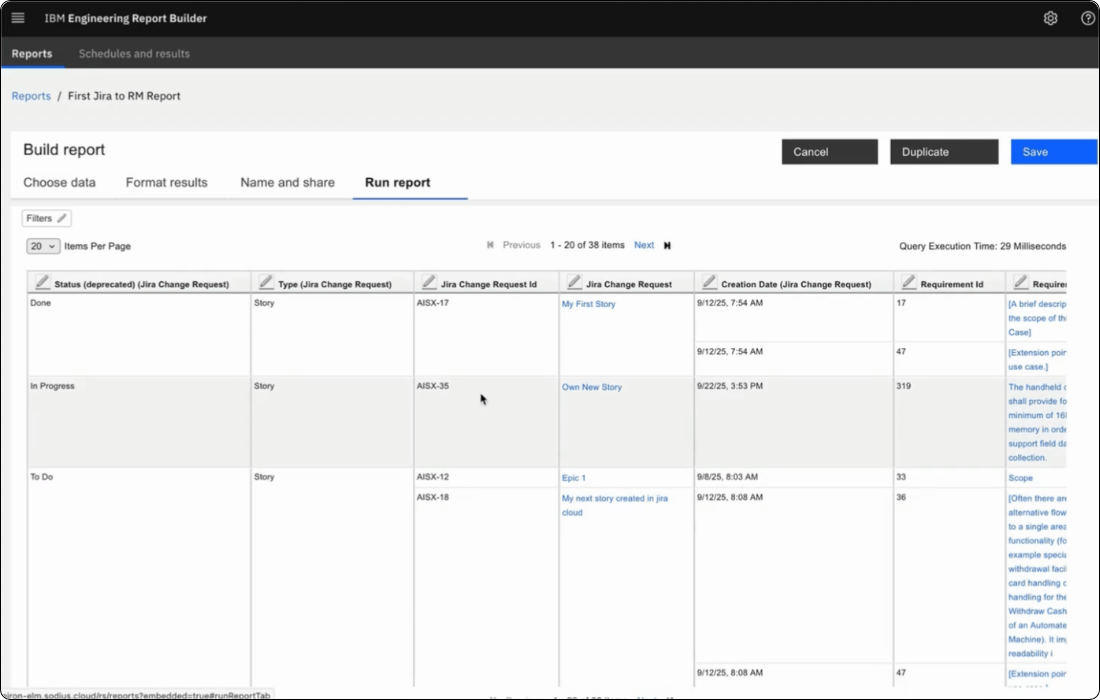
Report on Jira data in IBM Report Builder

OSLC Connect for Jira exposes Jira artifacts and their attributes directly into IBM Report Builder and the Lifecycle Query Engine (LQE).

Engineering managers can build cross-tool reports showing the complete traceability chain from DOORS Next requirement to Jira story (with live status) to test case to test result, with no manual data extraction. For ISO 26262, ASPICE, and DO-178C, this means audit evidence that's always current, always available, and never assembled by hand before a review.

Why engineering teams choose OSLC Connect for Jira Cloud to connect Jira to IBM DOORS Next

Connecting Jira to DOORS Next changes the kind of organization you can run: one where traceability holds up under audit, survives tool upgrades, and keeps engineering and delivery working from the same data.


Check mark_color_59x59px
Linked data, not synced data

Traditional integrations copy data between tools and try to keep the copies in sync, which means that links can quietly go stale between sync cycles. OSLC links don't copy anything: they resolve to the live artifact every time they're opened. There's no sync job to fail, no reconciliation backlog, and no question about which copy is authoritative, because they're is no copy.

Check mark_color_59x59px
Built on OSLC: Links that don't break when tools update

Because the integration runs on the open OSLC standard rather than a proprietary API, your links keep resolving when Atlassian ships a Jira update or IBM releases a new DOORS Next version. You're not waiting on a vendor-specific integration to catch up with someone else's release schedule, and you're not re-establishing links after every upgrade cycle.

Check mark_color_59x59px
Support for Global Configurations

Global Configuration support means the right requirement baseline and Jira release are always matched. This is essential when one program manages multiple roduct variants in parallel.

Check mark_color_59x59px
A full-circle, connected engineering organization

Requirements, test results, and delivery work stay linked end-to-end: from DOORS Next through ETM to Jira. Engineers, testers, and delivery teams can each navigate the full lifecycle from whichever tool they're already in, working as one connected organization.

Check mark_color_59x59px
Audit-ready traceability

OSLC Connect for Jira allows engineering teams to easily maintain a defensible, live trace from requirement to implementation to test to defect. Exactly what ASPICE, DO-178C/DO-254, and similar audits require you to demonstrate.

Check mark_color_59x59px
Linked data, not synced data

Traditional integrations copy data between tools and try to keep the copies in sync, which means that links can quietly go stale between sync cycles. OSLC links don't copy anything: they resolve to the live artifact every time they're opened. There's no sync job to fail, no reconciliation backlog, and no question about which copy is authoritative, because they're is no copy.

HOW IT WORKS

Three steps to connected traceability between Jira and IBM DOORS Next

Deploy the Broker

Install the OSLC Connect Forge app from the Atlassian Marketplace and deploy the lightweight Broker (a Tomcat web application with a small PostgreSQL database) with network access to Jira Cloud and your OSLC-compliant engineering tools. Contact us to get access to the Broker.

Configure the connection

Authenticate Jira Cloud and DOORS Next through OAuth 2.0, then configure which projects, domains, and Global Configurations participate in the integration.

Link, trace, and report

Create links from Jira or DOORS Next, generate defects from test execution, and feed live relationship data into IBM Report Builder for ongoing compliance and program reporting.

Pricing calculator

Estimate the cost of your future OSLC connector for Jira.

Use our calculator to configure a cost estimate that fits your unique business needs.

  1. 1
    Team size:
    Jira users
  2. 2
    Select your hosting platform:
  3. 3
    Do you need advanced features for Reporting and Global Configuration in IBM ELM?

OSLC Connect for Jira pricing estimate

Our app is sold as an annual subscription. You are eligible for support and automatic version updates as long as your subscription is active.

Your estimate:

  • OSLC Connect for Jira pricing estimate

    Cloud, annual subscription

    $- USD / year

    for - Jira users

  • TRS/GC option for IBM ELM

    Cloud, annual subscription

    $- USD / year

    for - Jira users

Total estimated cost:

$- USD / year

for - Jira users

RESOURCES

Learn more before you get started

Explore documentation, installation guidance, and migration support to understand what deploying OSLC Connect for Jira looks like in your environment.

Jira + IBM DOORS Next Integration Frequently Asked Questions

What do I need to install OSLC Connect for Jira Cloud?

You need an active Jira Cloud site with administrator access, and a server environment to host the Broker application (a Tomcat-based web app with a small PostgreSQL database). The Broker needs a public domain with a valid SSL certificate and outbound access to both Atlassian APIs and your OSLC-compliant engineering tools, such as IBM DOORS Next. Contact us for an evaluation of OSLC Connect for Jira Cloud.

Is there a free trial available?

Yes. OSLC Connect for Jira can be downloaded and tried for free for 30 days directly through the Atlassian Marketplace. Click here to get the app.

Does the integration synchronize or copy requirement data into Jira?
No. OSLC maintains a federated architecture: requirements remain in DOORS Next, issues remain in Jira. Instead of syncing data, OSLC Connect for Jira provides dynamic previews, rich link navigation, and cross-tool visibility. This avoids duplication, ensures accuracy, and aligns with enterprise IT expectations for security and repository integrity.
Can Jira users create or link to DOORS Next requirements?

Yes. Jira users can create, select, or link requirements from within Jira using native DOORS Next selection dialogs. They can also drag-and-drop DOORS items or paste URLs to create OSLC links. Administrators can restrict which link types or actions are allowed to enforce organizational process rules.

Does the integration support Global Configurations (GC)?

Yes. OSLC Connect for Jira supports IBM Global Configurations natively. Jira fix versions or releases can be mapped to OSLC Global Configurations, so links resolve against the correct requirement baseline for each configuration context. This is essential for programs managing product variants, parallel development streams, or formal design review baselines. See the Global Configurations feature section above for more detail.

Can we run lifecycle reports that include Jira and DOORS data together?

Yes. The integration exposes Jira artifacts and their attributes into IBM’s reporting infrastructure (LQE, Report Builder). Teams can build cross-tool reports showing requirement coverage, implementation progress, defect impact, change sets, and more, supporting compliance, analytics, and decision-making.

What kind of support is included with the solution?

Support includes standard SodiusWillert enterprise support: assistance with configuration, troubleshooting, onboarding guidance, and best practices for OSLC across your IBM ELM and Jira environments. As with all SodiusWillert enterprise integrations, the solution is designed to meet expectations for scalability, performance, security, and IT supportability.

How do we get help if we have questions during the trial?

During your evaluation, you can contact the SodiusWillert support team for technical questions, setup guidance, and best practices. You can access our Support portal here.

How much does OSLC Connect for Jira cost?

Pricing is based on Jira user tiers and is available directly on the Atlassian Marketplace listing. Use the pricing calculator on this page for an estimate, or contact us for a quote.

We're already using OSLC Connect for Jira Data Center. Can we migrate?

Yes. Our migration tooling supports moving OSLC links, configurations, and project associations from Jira Data Center to Jira Cloud when migration is performed through Atlassian's native JCMA tooling. We recommend engaging our team early to plan your migration.

Contact us via our contact form, or create a support ticket for your migration (Go to Support Portal ↗), so we review your specific scenario and advise on each one individually.

Ready to Connect Jira and IBM DOORS Next?

Eliminate the traceability gap between your systems engineers and software teams. OSLC Connect for Jira connects IBM DOORS Next and Jira Software with live, standards-based links.

Fichier 1 1 1
MORE SOLUTIONS

Extend IBM DOORS Next with SodiusWillert's solutions

OSLC Connect for Jira is one part of SodiusWillert's broader IBM ELM ecosystem.